Drive Your Plow Over the Bones of the Dead Review
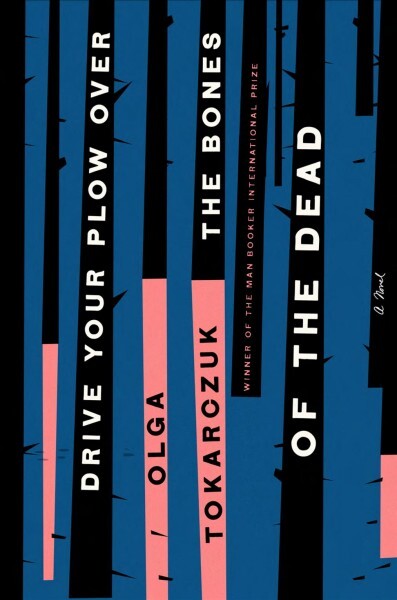
Drive Your Plow over the Bones of the Dead
Two things stand up out about Olga Tokarczuk's novel Bulldoze Your Plow Over the Basic of the Dead. The first is that the volume, showtime published in Polish in 2009 and newly translated by Antonia Lloyd-Jones, doesn't seem dated in the slightest; in fact, it fits rather well into much more contemporary literary concerns well-nigh nature and the impact humans have on information technology, and the cruelty of hunting and killing animals (Lauren Groff'south wonderful Florida comes to heed).
The 2d is that it is tempting to summarize the entirety of the narrative — a whodunit! — as saucier than it is actually is; tempting, but also very wrong. Tokarczuk is fundamentally a portraitist, a writer with a swell sense for sniffing out the incongruities that make a person — on brandish in her much-lauded novel, Flights, and here. Should she happen upon a whodunit, great!
Here, Tokarczuk'south protagonist is Janina — an aging astrologist who lives in a secluded Shine village correct on the Czech-Smoothen border, who spends her fourth dimension pontificating in capitalizations (Mankind, Darkness, or Perpetual Lite) and translating the poetry of one William Blake. Naturally, everyone effectually her thinks she'southward an anarchic crank. It's easy to invest in Janina, so thoroughly imagined is she as a character; even easier to hope that she'south correct in thinking the expressionless bodies turning up all effectually her are acts of revenge — by animals, on the local hunters.
Janina's story suffers from a full general sense of lassitude in its first tertiary — a result of frustrated expectations brought on by an exaggeratedly-pulpy cover blurb. But Tokarczuk also pulls off some nearly-impossible feats. To get a reader to believe even fictitiously in the power of Janina's astrological readings requires a sense of staunch belief that she is indeed onto something. And in doing and then, the story has Janina, and the reader, hitting the limits of adequacy, of believability, fifty-fifty a existent and tangible limit — like a national border. There's an extended metaphor, for case, wherein the Czech-Polish edge indicates Janina'southward sense of brake. Later on a neighbor winds upwardly dead, Janina pulls out her cell phone to phone call the police: "Soon afterward an automatic Czech vocalism responded. That's what happens here. The signal wanders, with no regard for the national borders ... its arbitrary nature is difficult to predict." Later on, Janina treads to and fro along the border, as if testing out the limits of sovereignty. Limits are at the heart of the matter here — the selective limits placed on some human being lives, like the elderly Janina, and not others, like voracious village hunters.
The friction generated betwixt Janina and the hunters powers the entire narrative. When 1 hunter reassures an irate Janina that he and his friends are "only" shooting pheasants, she feels "a surge of Anger, genuine, not to say Divine Anger ... There was a fire burning inside me, like a neutron star." For Janina, the killing of innocent creatures is murder, and even if you lot don't quite share the depths of her anger, y'all are likely to understand it. How could i not sympathize with a woman so thoroughly thwarted in protecting fauna life? Presently afterward her run-in with the hunters, she sits in her car and weeps "out of helplessness ... I pressed my face confronting the steering wheel. The horn responded sadly, like a summons. Like a cry of mourning." Which is one way of saying: Even if y'all don't believe hunting isn't a moral transgression, Janina is a sympathetic person — and, despite her loosey-goosey spiritualism, persuasive too. Equally far every bit Drive Your Plough into the Bones of the Dead is a paean to nature, information technology works precisely because it works solely through the graphic symbol of Janina, sidestepping a more sweeping polemic.
And in that location is a polemic — or at least a lament — subconscious in the subtext: Bulldoze Your Plow Over the Bones of the Expressionless is a sort of ode to Blake (whose verse opens each affiliate, and whose verse Janina translates — in i hysterical sequence, iii different ways: "a complicated form of Scrabble"). Blake: the philosopher and poet then preoccupied the respecting the innocence of the natural world. And in tying Janina with Blake so closely, Tokarczuk manages to link Blake'due south sharp indictment of human encroachment into nature with Janina's horror at the hunting and killing of animals, and the creep of man corruption into the Polish wilderness.
And ultimately, the novel is a complaining for the solitary, dismissed Janina too. "What have yous done in life?" a man asks Janina. And she's left speechless. "For people of my age," she thinks, "the places that they truly loved and to which they once belonged are no longer there. The places of their childhood and youth have ceased to exist ... And if their outer class has been preserved, it'southward all the more painful, like a shell with nothing inside it anymore. I have nowhere to render to. It's like a land of imprisonment. The walls of the prison cell are the horizon of what I can see."
It may exist worth to ask: Does Tokarczuk transcend Blake? Arguable — perhaps. Does she render the limits of human endeavour more viscerally than Blake? Arguable — perhaps.
That there may not be a clean respond to the question is a gift of its very own. Afterward all, possibly Blake'south philosophical grandiosity is only as potent as the old adult female who knows all nearly the limits placed on her, and rail confronting them nonetheless.
Kamil Ahsan is a biologist, historian and writer based in New Haven. He is an editor at Barrelhouse and his piece of work has appeared in the Los Angeles Review of Books, The American Prospect, Salon and Chicago Review, amongst other places.
Source: https://www.npr.org/2019/08/16/751323423/drive-your-plow-is-philosophical-lament-disguised-as-a-whodunit
0 Response to "Drive Your Plow Over the Bones of the Dead Review"
Post a Comment