Expect Great Things Attempt Great Things Book Review Doc
| The Reverend William Carey | |
|---|---|
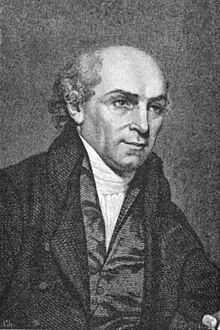 Portrait of Carey, c. 1887 | |
| Born | (1761-08-17)17 Baronial 1761 Paulerspury, England |
| Died | 9 June 1834(1834-06-09) (aged 72) Serampore, Bengal Presidency, British India |
| Signature | |
 | |
William Carey (17 August 1761 – 9 June 1834) was an English Christian missionary, Particular Baptist minister, translator, social reformer and cultural anthropologist who founded the Serampore College and the Serampore University, the start caste-awarding academy in India.[i]
He went to Calcutta (Kolkata) in 1793, only was forced to exit the British Indian territory by non-Baptist Christian missionaries.[2] He joined the Baptist missionaries in the Danish colony of Frederiksnagar in Serampore. Ane of his beginning contributions was to starting time schools for impoverished children where they were taught reading, writing, accounting and Christianity.[iii] He opened the first theological academy in Serampore offering divinity degrees,[4] [5] and campaigned to finish the do of sati.[half dozen]
Carey is known as the "male parent of modern missions."[7] His essay, An Research into the Obligations of Christians to Apply Ways for the Conversion of the Heathens, led to the founding of the Baptist Missionary Society.[2] [8] The Asiatic Society commended Carey for "his eminent services in opening the stores of Indian literature to the knowledge of Europe and for his extensive acquaintance with the science, the natural history and botany of this country and his useful contributions, in every branch."[nine]
He translated the Hindu classic, the Ramayana, into English,[10] and the Bible into Bengali, Oriya, Assamese, Marathi, Hindi and Sanskrit.[2] William Carey has been chosen a reformer and illustrious Christian missionary.[eleven] [12] [13]
Early on life [edit]

William Carey's motto on a hanging in St James' Church, Paulerspury, Northamptonshire, which he attended every bit a boy
William Carey, the oldest of v children, was built-in to Edmund and Elizabeth Carey, who were weavers past trade, in the hamlet of Pury Terminate in the parish of Paulerspury, Northamptonshire.[xiv] [15] William was raised in the Church building of England; when he was six, his male parent was appointed the parish clerk and hamlet schoolmaster. As a kid he was inquisitive and keenly interested in the natural sciences, specially botany. He possessed a natural gift for linguistic communication, instruction himself Latin.
At the age of 14, Carey's father apprenticed him to a cordwainer in the nearby hamlet of Piddington, Northamptonshire.[sixteen] His master, Clarke Nichols, was a churchman like himself, merely another amateur, John Warr, was a Dissenter. Through his influence Carey would leave the Church of England and join with other Dissenters to form a small Congregational church building in nearby Hackleton. While apprenticed to Nichols, he as well taught himself Greek with the help of Thomas Jones, a local weaver who had received a classical pedagogy.
When Nichols died in 1779, Carey went to work for the local shoemaker, Thomas Erstwhile; he married Old'due south sis-in-police Dorothy Plackett in 1781 in the Church building of St John the Baptist, Piddington. Unlike William, Dorothy was illiterate; her signature in the marriage register is a crude cross. William and Dorothy Carey had 7 children, five sons and two daughters; both girls died in infancy, equally did son Peter, who died at the historic period of 5. Thomas One-time himself died soon afterwards, and Carey took over his business, during which time he taught himself Hebrew, Italian, Dutch, and French, often reading while working on the shoes.[ citation needed ]
Carey best-selling his humble origins and referred to himself as a cobbler. John Brownish Myers entitled his biography of Carey William Carey the Shoemaker Who Became the Begetter and Founder of Modern Missions.
Founding of the Baptist Missionary Order [edit]
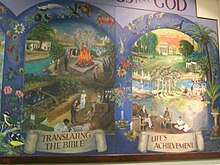
Detail from wall hanging depicting Carey's life, in Carey Baptist Church building, Moulton, Northamptonshire
Carey became involved with a local association of Item Baptists that had recently formed, where he became acquainted with men such as John Ryland, John Sutcliff, and Andrew Fuller, who would go his close friends in subsequently years. They invited him to preach in their church in the nearby village of Earls Barton every other Sunday. On 5 October 1783, William Carey was baptised past Ryland and committed himself to the Baptist denomination.

In 1785, Carey was appointed the schoolmaster for the hamlet of Moulton. He was besides invited to serve as pastor to the local Baptist church building. During this time he read Jonathan Edwards' Account of the Life of the Late Rev. David Brainerd and the journals of the explorer James Cook, and became concerned with propagating the Christian Gospel throughout the world. John Eliot (c. 1604 – 21 May 1690), Puritan missionary in New England, and David Brainerd (1718–47) became the "canonized heroes" and "enkindlers" of Carey.[17]
In 1789 Carey, became the full-time pastor of Harvey Lane Baptist Church in Leicester. 3 years later, in 1792, he published his groundbreaking missionary manifesto, An Research into the Obligations of Christians to use Means for the Conversion of the Heathens. This short volume consists of five parts. The first part is a theological justification for missionary activity, arguing that the command of Jesus to make disciples of all the world (Matthew 28:xviii-20) remains bounden on Christians.[18]
The second part outlines a history of missionary action, beginning with the early Church and ending with David Brainerd and John Wesley.[19]
Part 3 comprises 26 pages of tables, list expanse, population, and religion statistics for every country in the world. Carey had compiled these figures during his years as a schoolteacher. The fourth part answers objections to sending missionaries, such as difficulty learning the language or danger to life. Finally, the fifth role calls for the germination past the Baptist denomination of a missionary society and describes the applied means by which it could exist supported. Carey'southward seminal pamphlet outlines his basis for missions: Christian obligation, wise apply of bachelor resource, and accurate data.[ citation needed ]
Carey subsequently preached a pro-missionary sermon (the Deathless Sermon), using Isaiah 54:2–three as his text, in which he repeatedly used the epigram which has become his near famous quotation:
Expect swell things from God; attempt dandy things for God.
Carey finally overcame the resistance to missionary effort, and the Item Baptist Gild for the Propagation of the Gospel Amid the Pagan (subsequently the Baptist Missionary Society and since 2000 BMS World Mission) was founded in October 1792, including Carey, Andrew Fuller, John Ryland, and John Sutcliff equally charter members. They so concerned themselves with practical matters such as raising funds, as well every bit deciding where they would direct their efforts. A medical missionary, Dr John Thomas, had been in Calcutta and was in England raising funds; they agreed to back up him and that Carey would accompany him to India.
Missionary life in Republic of india [edit]

Black-and-white lantern slide ca 1920, showing the grave at Serampore of William Carey and his second wife Charlotte Emilia Carey (1761-1821) and 3rd wife Grace Carey (d. 1835)
Carey, his eldest son Felix, Thomas and his wife and daughter sailed from London aboard a British send in Apr 1793. Dorothy Carey had refused to leave England, beingness significant with their 4th son and having never been more than a few miles from domicile; but earlier they left they asked her again to come up with them and she gave consent, with the knowledge that her sister Kitty would assist her give nascency. En route they were delayed at the Isle of Wight, at which time the captain of the send received give-and-take that he endangered his command if he conveyed the missionaries to Calcutta, as their unauthorised journeying violated the merchandise monopoly of the British East India Company. He decided to sheet without them, and they were delayed until June when Thomas found a Danish captain willing to offer them passage. In the meantime, Carey'south married woman, who had by now given birth, agreed to accompany him provided her sister came also. They landed at Calcutta in November.[twenty]
During the commencement year in Calcutta, the missionaries sought means to support themselves and a place to establish their mission. They likewise began to larn the Bengali language to communicate with others. A friend of Thomas owned two indigo factories and needed managers, so Carey moved with his family due west to Midnapore. During the six years that Carey managed the indigo plant, he completed the first revision of his Bengali New Testament and began formulating the principles upon which his missionary customs would be formed, including communal living, financial self-reliance, and the grooming of indigenous ministers. His son Peter died of dysentery, which, along with other causes of stress, resulted in Dorothy suffering a nervous breakdown from which she never recovered.[20]
Meanwhile, the missionary club had begun sending more missionaries to India. The first to arrive was John Fountain, who arrived in Midnapore and began teaching. He was followed by William Ward, a printer; Joshua Marshman, a schoolteacher; David Brunsdon, 1 of Marshman'south students; and William Grant, who died three weeks later on his arrival. Because the East India Company was still hostile to missionaries, they settled in the Danish colony in Serampore and were joined in that location by Carey on 10 January 1800.[20]
Tardily Indian period [edit]

Carey lived here at the Serampore College
Once settled in Serampore, the mission bought a house large plenty to adjust all of their families and a school, which was to be their main means of back up. Ward ready up a print shop with a secondhand press Carey had acquired and began the task of press the Bible in Bengali. In August 1800 Fountain died of dysentery. By the finish of that year, the mission had their first convert, a Hindu named Krishna Pal. They had also earned the goodwill of the local Danish government and Richard Wellesley, then Governor-General of Bharat.
The conversion of Hindus to Christianity posed a new question for the missionaries apropos whether information technology was appropriate for converts to retain their caste. In 1802, the daughter of Krishna Pal, a Sudra, married a Brahmin. This wedding was a public demonstration that the church building repudiated the caste distinctions.
Brunsdon and Thomas died in 1801. The same year, the Governor-General founded Fort William Higher, a college intended to educate civil servants. He offered Carey the position of professor of Bengali. Carey's colleagues at the college included pundits, whom he could consult to correct his Bengali testament. One of his colleagues was Madan Mohan Tarkalankar who taught him the Sanskrit language. He also wrote grammars of Bengali and Sanskrit, and began a translation of the Bible into Sanskrit. He also used his influence with the Governor-General to help put a stop to the practices of baby sacrifice and suttee, after consulting with the pundits and determining that they had no basis in the Hindu sacred writings (although the latter would not be abolished until 1829).
Dorothy Carey died in 1807.[21] Due to her debilitating mental breakdown, she had long since ceased to be an able member of the mission, and her condition was an boosted brunt to information technology. John Marshman wrote how Carey worked away on his studies and translations, "…while an insane married woman, oftentimes wrought up to a state of most sad excitement, was in the next room…".
Several friends and colleagues had urged William to commit Dorothy to an aviary. But he recoiled at the thought of the treatment she might receive in such a place and took the responsibility to keep her within the family unit home, even though the children were exposed to her rages.[22]
In 1808 Carey remarried. His new wife Charlotte Rhumohr, a Danish member of his church was, different Dorothy, Carey's intellectual equal. They were married for thirteen years until her death.
From the printing printing at the mission came translations of the Bible in Bengali, Sanskrit, and other major languages and dialects. Many of these languages had never been printed before; William Ward had to create punches for the type by hand. Carey had begun translating literature and sacred writings from the original Sanskrit into English to brand them accessible to his own countryman. On xi March 1812, a burn in the print shop caused £10,000 in damages and lost work. Among the losses were many irreplaceable manuscripts, including much of Carey'due south translation of Sanskrit literature and a polyglot dictionary of Sanskrit and related languages, which would have been a seminal philological work had it been completed. However, the press itself and the punches were saved, and the mission was able to continue printing in half-dozen months. In Carey's lifetime, the mission printed and distributed the Bible in whole or part in 44 languages and dialects.
Also, in 1812, Adoniram Judson, an American Congregational missionary en route to India, studied the scriptures on baptism in preparation for a meeting with Carey. His studies led him to get a Baptist. Carey'southward urging of American Baptists to accept over back up for Judson'southward mission, led to the foundation in 1814 of the showtime American Baptist Mission lath, the Full general Missionary Convention of the Baptist Denomination in the United States of America for Foreign Missions, afterwards commonly known as the Triennial Convention. Most American Baptist denominations of today are straight or indirectly descended from this convention.
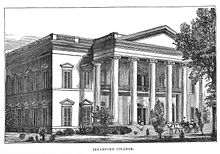
In 1818, the mission founded Serampore Higher to train indigenous ministers for the growing church and to provide education in the arts and sciences to anyone regardless of caste or land. Frederick VI, King of Denmark, granted a royal charter in 1827 that made the college a degree-granting institution, the first in Asia.[23]
In 1820 Carey founded the Agri Horticultural Club of India at Alipore, Calcutta, supporting his enthusiasm for phytology. When William Roxburgh went on leave, Carey was entrusted to maintain the Botanical Garden at Calcutta. The genus Careya was named after him.[24]
Carey'due south second married woman, Charlotte, died in 1821, followed past his eldest son Felix. In 1823 he married a tertiary time, to a widow named Grace Hughes.
Internal dissent and resentment was growing within the Missionary Social club as its numbers grew, the older missionaries died, and they were replaced by less experienced men. Some new missionaries arrived who were not willing to live in the communal manner that had adult, one going so far as to demand "a dissever house, stable and servants." Unused to the rigorous work ethic of Carey, Ward, and Marshman, the new missionaries thought their seniors – particularly Marshman – to be somewhat dictatorial, assigning them work not to their liking.
Andrew Fuller, who had been secretary of the Society in England, had died in 1815, and his successor, John Dyer, was a bureaucrat who attempted to reorganise the Society along business lines and manage every item of the Serampore mission from England. Their differences proved to exist irreconcilable, and Carey formally severed ties with the missionary society he had founded, leaving the mission property and moving onto the college grounds. He lived a quiet life until his death in 1834, revising his Bengali Bible, preaching, and education students. The couch on which he died, on 9 June 1834, is now housed at Regent's Park College, the Baptist hall of the University of Oxford.
Life in India [edit]
Much of what is known almost Carey's activities in Republic of india is from missionary reports sent back dwelling. Historians such as Comaroffs, Thorne, Van der Veer and Brian Pennington note that the representation of India in these reports must be examined in their context and with care for its evangelical and colonial ideology.[12] The reports by Carey were conditioned by his background, personal factors and his own religious beliefs. The polemic notes and observations of Carey, and his colleague William Ward, were in a customs suffering from extreme poverty and epidemics, and they synthetic a view of the culture of India and Hinduism in calorie-free of their missionary goals.[12] [26] These reports were by those who had declared their confidence in foreign missionary work, and the letters describe experiences of foreigners who were resented by both the Indian populace as well as European officials and competing Christian groups. Their accounts of culture and Hinduism were forged in Bengal that was physically, politically and spiritually difficult to preach in.[12] Pennington summarises the accounts reported by Carey and his colleagues as follows,
Plagued with anxieties and fears near their own health, regularly reminded of colleagues who had lost their lives or reason, uncertain of their own social location, and preaching to crowds whose reactions ranged from indifference to amusement to hostility, missionaries found expression for their darker misgivings in their production of what is surely part of their speckled legacy: a fabricated Hinduism crazed by blood-lust and devoted to the service of devils.[12]
Carey recommended that his fellow Anglo-Indians learn and translate Sanskrit in a manner "compatible with colonial aims",[27] writing that "to proceeds the ear of those who are thus deceived, information technology is necessary for them to believe that the speaker has a superior noesis of the subject. In these circumstances, knowledge of Sanskrit is valuable."[27] Co-ordinate to Indian historian V. Rao, Carey lacked understanding and respect for Indian culture, with him describing Indian music every bit "icky" and bringing to listen practices "dishonorable" to God. Such attitudes affected the literature authored by Carey and his colleagues.[13]
Family history [edit]
Biographies of Carey, such as those past F. D. Walker[28] and J. B. Myers, only insinuate to Carey's distress caused by the mental illness and subsequent breakup suffered by his wife, Dorothy, in the early years of their ministry in India. More than recently, Beck's biography of Dorothy Carey paints a more detailed movie: William Carey uprooted his family unit from all that was familiar and sought to settle them in one of the most unlikely and difficult cultures in the globe for an uneducated eighteenth century British working-class woman. Faced with enormous difficulties in adjusting to all of this change, she failed to make the aligning emotionally and ultimately, mentally, and her husband seemed to exist unable to help her through all of this considering he simply did non know what to do about it.[29] Carey fifty-fifty wrote to his sisters in England on 5 October 1795, that "I have been for some time past in danger of losing my life. Jealousy is the nifty evil that haunts her mind."[thirty]
Dorothy's mental breakdown ("at the same fourth dimension William Carey was baptizing his first Indian convert and his son Felix, his married woman was forcefully confined to her room, raving with madness"[31]) led inevitably to other family bug. Joshua Marshman was appalled by the neglect with which Carey treated his four boys when he first met them in 1800. Aged 4, 7, 12 and 15, they were unmannered, undisciplined, and fifty-fifty uneducated.[ citation needed ]
Eschatology [edit]
Too Iain Murray'due south written report, The Puritan Hope,[32] less attention has been paid in Carey'due south numerous biographies to his postmillennial eschatology as expressed in his major missionary manifesto, notably non even in Bruce J. Nichols' article "The Theology of William Carey."[33] Carey was a Calvinist."[34] and a postmillennialist. Even the two dissertations which discuss his achievements (past Oussoren[35] and Potts[36]) ignore large areas of his theology. Neither mention his eschatological views, which played a major role in his missionary zeal.[37] One exception, found in James Brook'southward biography of his first wife,[29] mentions his personal optimism in the affiliate on "Attitudes Towards the Future," just not his optimistic perspective on world missions, which he derived from postmillennial theology.[38]
Translation, education and schools [edit]

Carey's desk at the Serampore College
Carey devoted great efforts and time to the study not only of the common language of Bengali, merely to many other Indian vernaculars including the ancient root language of Sanskrit. In collaboration with the Higher of Fort William, Carey undertook the translation of the Hindu classics into English, outset with the three-volume epic poem the Ramayana. He then translated the Bible into Bengali, Oriya, Marä thi, Hindi, Assamese, Sanskrit and parts of information technology into other dialects and languages.[39] For 30 years Carey served in the college as the professor of Bengali, Sanskrit and Marathi,[39] [40] publishing, in 1805, the start book on Marathi grammar.[41] [42]
The Serampore Mission Press that Carey founded is credited as the simply press which "consistently idea information technology of import enough that costly fonts of type be cast for the irregular and neglected languages of the Indian people."[43] Carey and his team produced textbooks, dictionaries, classical literature and other publications which served main school children, college-level students and the full general public, including the first systematic Sanskrit grammer which served a model for later publications.[44]
In the latter 1700s and early on 1800s in India, only children of certain social strata received education, and even that was limited to basic accounting and Hindu organized religion. Only the Brahmins and writer castes could read, and and then merely men, women being completely unschooled. Carey started Sunday Schools in which children learned to read using the Bible equally their textbook.[45] In 1794 Carey opened, at his own price, what is considered the kickoff primary school in all of India.[46] The public school organization that Carey initiated expanded to include girls in an era when the education of the female person was considered unthinkable. Carey's work is considered to have provided the starting betoken of what blossomed into the Christian Vernacular Educational activity Society providing English medium didactics beyond India.[47]
Legacy and influence [edit]
William Carey spent 41 years in Bharat without a furlough. His mission counted some 700 converts in a nation of millions, simply he had laid an impressive foundation of Bible translations, education, and social reform.[48] He has been referred to every bit the "male parent of modern missions",[7] and as "India's outset cultural anthropologist."[49]
His education, translations, writings and publications, his educational establishments and influence in social reform are said to have "marked the turning point of Indian civilisation from a downward to an up trend."
[Carey] saw India non as a foreign country to be exploited, but as his heavenly Father's country to be loved and saved... he believed in understanding and decision-making nature instead of fearing, appeasing or worshipping information technology; in developing one's intellect instead of killing it as mysticism taught. He emphasized enjoying literature and culture instead of shunning it as maya.
Carey was instrumental in launching Serampore College in Serampore.[51]
Carey'due south passionate insistence on change resulted in the founding of the Baptist Missionary Society.[52]
Carey has at to the lowest degree 11 schools named afterward him: William Carey Christian School (WCCS) in Sydney, NSW, William Carey International University, founded in 1876 in Pasadena, California, Carey Theological College in Vancouver, British Columbia, Carey Baptist College in Auckland, New Zealand, Carey Baptist Grammar School in Melbourne, Victoria, Carey College in Colombo, Sri Lanka, William Carey Academy, founded in Hattiesburg, Mississippi, in 1892,[53] and Carey Baptist College in Perth, Australia. The William Carey Academy of Chittagong, Bangladesh teaches both Bangladeshi and departer children, from kindergarten to grade 12, and the William Carey Memorial School, (A Co-ed English Medium), operates in Serampore, Hooghly. An English medium school named William Carey International School was established on 17 August 2008 in Dhaka, Bangladesh.
Artefacts [edit]
St James Church in Paulerspury, Northamptonshire, where Carey was christened and attended equally a boy, has a William Carey brandish. Carey Baptist Church in Moulton, Northamptonshire, also has a display of artefacts related to William Carey, as well as the nearby cottage where he lived.[54]
In Leicester, Harvey Lane Baptist Church, the last church in England where Carey served earlier he left for India, was destroyed by a burn down in 1921. Carey'southward nearby cottage had served as a 'Memories of Carey' museum from 1915 until it was destroyed to make way for a new road system in 1968.[55] Artefacts from the museum were given to Fundamental Baptist Church in Charles Street, Leicester which houses the William Carey Museum.[56] [57]
Angus Library and Archive in Oxford holds the largest single collection of Carey messages as well as numerous artefacts such as his Bible and the sign from his cordwainer shop. There is a large collection of historical artefacts including messages, books, and other artefacts that belonged to Carey at the Center for Study of the Life and Work of William Carey at Donnell Hall on the William Carey University Hattiesburg campus.[58]
See also [edit]
- Carey Baptist Church in Reading, England
- Carey Saheber Munshi
- William Carey University, Meghalaya
Notes [edit]
- ^ Vishal Mangalwadi (1999), The Legacy of William Carey: A Model for the Transformation of a Culture, pp. 61–67, ISBN 978-one-58134-112-6
- ^ a b c William Carey British missionary Encyclopædia Britannica.
- ^ Riddick, John F. (2006). The History of British India: A Chronology. Praeger Publications. p. 158. ISBN0-313-32280-5.
- ^ "Northants celebrates 250th anniversary of William Carey". BBC News. 18 August 2011. Retrieved seven November 2016.
- ^ Smith, George (1922). The Life of William Carey: Shoemaker & Missionary. J. M. Dent & Co. p. 292.
- ^ Sharma, Arvind (1988). Sati: Historical and Phenomenological Essays. Motilal Benarasidass. pp. 57–63. ISBN81-208-0464-3.
- ^ a b Gonzalez, Justo L. (2010) The Story of Christianity Vol. 2: The Reformation to the Present Day, Zondervan, ISBN 978-0-06185589-4, p. 419
- ^ William Carey, An Enquiry into the Obligations of Christians to Use Means for the Conversion of the Heathens (1792; repr., London: Carey Kingsgate Printing, 1961)
- ^ Thomas, T. Jacob (1994). "Interaction of the Gospel and Culture in Bengal" (PDF). Indian Journal of Theology. Serampore College Theology Section and Bishop's College, Kolkata. 36 (ii): 46, 47.
- ^ Kopf, David (1969). British Orientalism and the Renaissance: The Dynamics of Indian Modernization 1778–1835. Calcutta: Firma Chiliad.L. Mukhopadhyay. pp. 70, 78.
- ^ Vishal Mangalwadi (1999), The Legacy of William Carey: A Model for the Transformation of a Culture, pp. 61-67, ISBN 978-i-58134112-vi
- ^ a b c d due east Brian K. Pennington (2005), Was Hinduism Invented?: Britons, Indians, and the Colonial Construction, pp. 76–77, Oxford Academy Printing
- ^ a b V Rao (2007), Contemporary Education, pp. 17-18, ISBN 978-81-3130273-half dozen
- ^ "Paulerspury: Pury End". The Carey Experience . Retrieved nine July 2016.
- ^ "William Carey's Historical Wall – Carey Road, Pury End, Northamptonshire, UK". UK Historical Markers. Waymarking.com. Retrieved 9 July 2016. Includes image of memorial stone
- ^ "Glimpses #45: William Carey's Amazing Mission". Christian History Establish. Archived from the original on 4 Apr 2005. Retrieved 11 February 2008.
- ^ Carpenter, John, (2002) "New England Puritans: The Grandparents of Modern Protestant Missions," Fides et Historia 30.four, 529.
- ^ AN ENQUIRY INTO THE OBLIGATIONS OF CHRISTIANS, TO USE MEANS FOR THE CONVERSION OF THE HEATHENS reprinted London: Carey Kingsgate Press, 1961
- ^ William Carey (1792), AN ENQUIRY INTO THE OBLIGATIONS OF CHRISTIANS, TO Utilise MEANS FOR THE CONVERSION OF THE HEATHENS reprinted London: Carey Kingsgate Press, 1961
- ^ a b c "Note from the preparer of this etext_ I take had to insert a view comments mainly in regards to adjustments to fonts to let".
- ^ William Carey'southward Less-than-Perfect Family Life, Christian History, Issue 36, 10 January 1992
- ^ Timothy George, The Life and Mission of William Carey, IVP, p. 158
- ^ The Senate of Serampore Higher
- ^ Culross, James (1882). William Carey. New York: A.C. Armstrong & Son. p. 190.
- ^ IPNI. Carey.
- ^ Robert Eric Frykenberg and Alaine M. Low (2003), Christians and Missionaries in India, pp. 156–157, ISBN 978-0-8028-3956-5
- ^ a b Silvia Nagy (2010), Colonization Or Globalization?: Postcolonial Explorations of Imperial Expansion, p. 62, ISBN 978-073-91-31763
- ^ Frank Deauville Walker, William Carey (1925, repr. Chicago: Moody Printing, 1980). ISBN 0-8024-9562-1.
- ^ a b Beck, James R. Dorothy Carey: The Tragic and Untold Story of Mrs. William Carey. Grand Rapids: Baker Book House, 1992. ISBN 0-8010-1030-6.
- ^ "Dorothy's Devastating Delusions," Christian History & Biography, 1 October 1992.
- ^ Book Review — Dorothy Carey: The Tragic And Untold Story Of Mrs. William Carey Archived fifteen September 2006 at the Wayback Automobile
- ^ Iain H. Murray, The Puritan Promise. Carlisle, PA: Banner of Truth, 1975. ISBN 0-85151-037-Ten.
- ^ "The Theology of William Carey," Evangelical Review of Theology 17 (1993): 369–80.
- ^ Yeh, Allan; Chun, Chris (2013). Look Great Things, Endeavor Great Things: William Carey and Adoniram Judson, Missionary Pioneers. Wipf and Stock. p. 13. ISBN9781610976145.
- ^ Aalbertinus Hermen Oussoren, William Carey, Specially his Missionary Principles (Diss.: Freie Universität Amsterdam), (Leiden: A. W. Sijthoff, 1945).
- ^ East. Daniels Potts. British Baptist Missionaries in India 1793–1837: The History of Serampore and its Missions, (Cambridge: University Press, 1967).
- ^ D. James Kennedy, "William Carey: Texts That Have Changed Lives" [ permanent expressionless link ] : "It was the conventionalities of these men that in that location was going to exist ushered in by the announcement of the Gospel a glorious gilded age of Gospel submission on the part of the heathen. Information technology is very interesting to note that theologically that is what is known every bit 'postmillennialism,' a view which is non very pop today, just was the view that animated all the men who were involved in the early missionary enterprise."
- ^ Thomas Schirrmacher, William Carey, Postmillennialism and the Theology of Earth Missions
- ^ a b "William Carey".
- ^ Smith, George (1885). The Life of William Carey, D.D.: Shoemaker and Missionary, Professor ..., Office iv. R & R Clark, Edinburgh. pp. 69–lxx.
- ^ Rao, Goparaju Sambasiva (1994). Language Change: Lexical Diffusion and Literacy. Bookish Foundation. pp. 48 and 49. ISBN978-81-7188-057-7. Archived from the original on 7 December 2014.
- ^ Carey, William (1805). A Grammer of the Marathi Language. Serampur: Serampore Mission Printing. ISBN978-1-108-05631-1.
- ^ Kopf, David (1969). British Orientalism and the Renaissance: The Dynamics of Indian Modernization 1778-1835. Calcutta: Firma K.Fifty. Mukhopadhyay. pp. 71, 78.
- ^ Brockington, John (1991–1992). "William Carey's Significance as an Indologist" (PDF). Indologica Taurinensia. 17–xviii: 87–88. Retrieved 29 January 2017.
- ^ Smith 1885, p. 150>
- ^ Smith 1885, p. 148>
- ^ Smith 1885, p. 102>
- ^ "William Carey". Christianity Today. Retrieved seven Nov 2016.
- ^ Kopf, David (1969). British Orientalism and the Renaissance: The Dynamics of Indian Modernization 1778–1835. Calcutta: Firma G.50. Mukhopadhyay. pp. 70, 78.
- ^ Mangalwadi, Vishal (1999). The Legacy of William Carey: A Model for the Transformation of a Civilization. pp. 24–25. ISBN978-1-58134-112-6.
- ^ Yeh page=39
- ^ Yeh, Allan; Chun, Chris (2013). Expect Great Things, Attempt Nifty Things: William Carey and Adoniram Judson, Missionary Pioneers. Wipf and Stock. p. 117. ISBN9781610976145.
- ^ "About William Carey". William Carey Academy. Retrieved 26 January 2017.
- ^ Cooper, Matthew. "The Carey Experience". Retrieved 7 November 2016.
- ^ "William Carey", Bluish plaques, Leicester .
- ^ "Central Baptist Church and William Carey Museum". Visit Leicester . Retrieved 1 March 2020.
- ^ "William Carey Museum". Primal Baptist . Retrieved xiii March 2020.
- ^ Middle for Written report of the Life and Work of William Carey, William Carey university .
References [edit]
- Chatterjee, Sunil Kumar. William Carey and Serampore, Calcutta, Ghosh publishing business organisation, 1984.
- Daniel, J.T.Grand.and Hedlund, R.E. (ed.). Carey's Obligation and Indian Renaissance, Serampore, Council of Serampore College, 1993.
- Chiliad.1000. Thomas. Significance of William Carey for India today, Makkada, Marthoma Diocesan Middle, 1993.
- Beck, James R. Dorothy Carey: The Tragic and Untold Story of Mrs. William Carey. Grand Rapids: Baker Book Business firm, 1992.
- Carey, William. An Enquiry into the Obligations of Christians to Use Means for the Conversion of the Heathens. Leicester: A. Ireland, 1791.
- An Inquiry into the Obligations of Christians to Utilise Means for the Conversion of the Heathens at Projection Gutenberg
- Chisholm, Hugh, ed. (1911). . Encyclopædia Britannica. Vol. five (11th ed.). Cambridge Academy Press.
- Lane-Poole, Stanley (1887). . In Stephen, Leslie (ed.). Dictionary of National Biography. Vol. ix. London: Smith, Elder & Co.
- Marshman, John Clark. Life and Times of Carey, Marshman and Ward Embracing the History of the Serampore Mission. two vols. London: Longman, 1859.
- Murray, Iain. The Puritan Promise: Revival and the Interpretation of Prophecy. Edinburgh: Imprint of Truth Trust, 1971.
- Nicholls, Bruce J. "The Theology of William Carey." In Evangelical Review of Theology 17 (1993): 372.
- Oussoren, Aalbertinus Hermen. William Carey, Specially his Missionary Principles. Leiden: A. Westward. Sijthoff, 1945.
- Potts, Due east. Daniels. British Baptist Missionaries in Bharat 1793–1837: The History of Serampore and its Missions. Cambridge: Academy Press, 1967.
- Smith, George. The Life of William Carey: Shoemaker and Missionary. London: Murray, 1887.
- The Life of William Carey: Shoemaker and Missionary at Projection Gutenberg
- Walker, F. Deauville. William Carey: Missionary Pioneer and Statesman. Chicago: Moody, 1951.
- Dutta, Sutapa. British Women Missionaries in Bengal, 1793-1861. U.Grand.: Canticle Press, 2017.
Further reading [edit]
- Carey, Eustace – Memoir of William Carey, D. D. Late missionary to Bengal, Professor of Oriental Languages in the College of Fort William, Calcutta. 1837, 2d Edition, Jackson & Walford: London.
- Carey, South. Pearce – William Carey "The Father of Modern Missions", edited by Peter Masters, Wakeman Trust, London, 1993 ISBN i-870855-xiv-0
- Cule, Due west.E. – The Bells of Moulton, The Carey Press, 1942 (Children's biography)
- A Grammer of the Bengalee Language (1801)
- Kathopakathan [কথোপকথন] (i.eastward. "Conversations") (1801)
- Itihasmala [ইতিহাসমালা] (i.e. "Chronicles") (1812)
External links [edit]
- The Church building of St John the Baptist, Piddington
- William Carey biographies Archived 14 April 2009 at the Wayback Machine
- Center for the study of the life and work of William Carey, United states of america includes Works by and about Carey
- Works by William Carey at Project Gutenberg
- Works by or about William Carey at Net Annal
- The William Carey Experience
- The Carey Exhibition, Central Baptist Church building, Leicester
- Missionary Marriage Issues: What Virtually Dorothy?
Source: https://en.wikipedia.org/wiki/William_Carey_(missionary)
0 Response to "Expect Great Things Attempt Great Things Book Review Doc"
Post a Comment